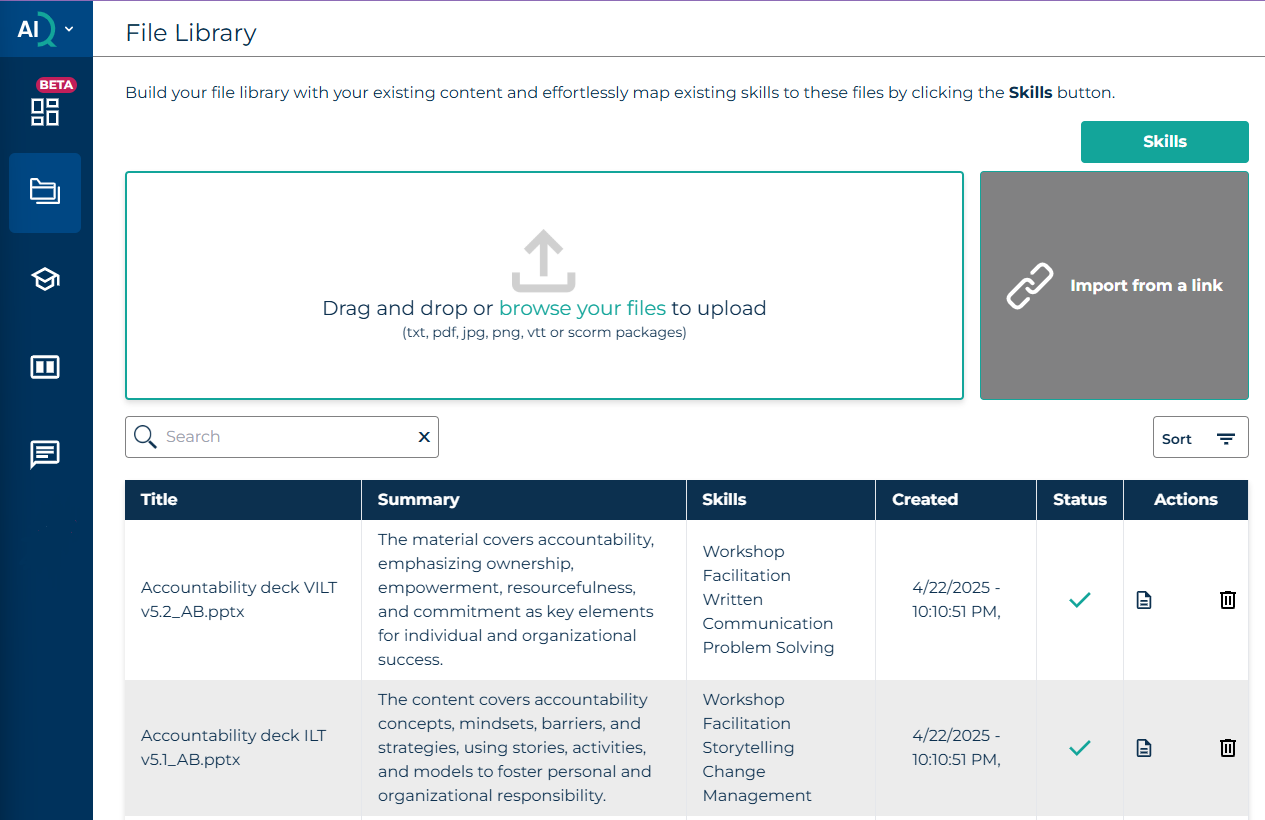
In the File library, you can access skills by selecting the Skills button, you can upload an existing skills taxonomy that will then be mapped to the content in your Library, allowing you to identify which skills are represented in which documents. This can then be used in content analysis and to support content creation.
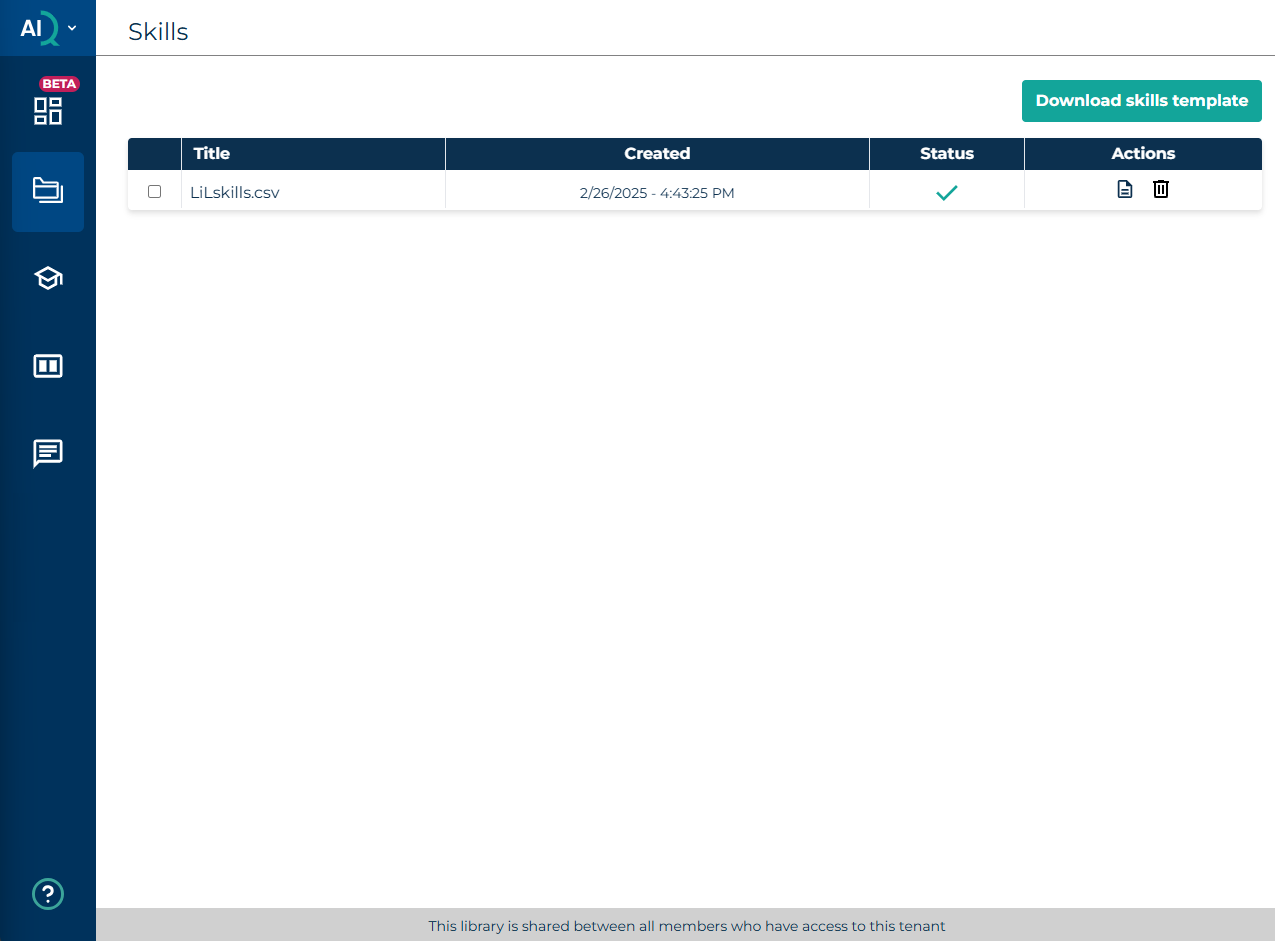
You can download a skills template which can be populated either by an existing taxonomy, or even one you created in Content AIQ, and then uploaded as a CSV file.
Once you have uploaded a skills taxonomy, it will analyse your content automatically to identify whether the content is relevant to specific skills. Note: depending on how comprehensive your skills taxonomy is, some content may not generate any skills matches. It is important to have a skills taxonomy that is relevant to your content, otherwise the content matches will be tenuous.
Open the file and complete the skills and descriptions fields with as much detail as possible. Here is an example of a set of skills with their descriptions.
| Skills | Descriptions |
| Additive Knowledge | Understanding different types of additives such as antioxidants, anti-wear, extreme pressure, lubricity additives, and their effects on lubricants and machinery. |
| Application Techniques | Properly applying lubricants to machinery components (e.g., bearings, gears, wire ropes) using methods like brushing, spraying, dripping, or passing through a reservoir. |
| Bearing Lubrication | Knowledge of lubricating different types of bearings, including ball, roller, and fluid film bearings, and understanding hydrodynamic and elastohydrodynamic lubrication. |
| Compatibility Checks | Consulting OEMs and technical support before changing lubricants to ensure compatibility and understanding the procedures to flush systems when switching oils. |
| Contamination Control | Implementing techniques to prevent and manage contamination in lubricants through proper storage, handling, and filtration. |
| Data Recording and Labeling | Accurately labeling oil samples and recording relevant data to ensure correct analysis and avoid contamination. |
| Equipment Maintenance | Regular maintenance and cleaning of lubrication systems, including replacing filters and monitoring lubricant levels. |
| Filtration and Purification | Using various filtration methods (gravity, centrifugal, mechanical, coalescence, vacuum dehydration, adsorption) to maintain lubricant purity and performance. |
| Grease Application and Management | Knowledge of grease types, their properties, and application techniques, including issues like over-lubrication and grease compatibility. |
| Handling and Storage | Proper techniques for storing and handling lubricants to avoid contamination and maintain quality, including the use of filters and desiccant breathers. |
| Inspection and Diagnosis | Identifying signs of lubricant degradation, contamination, and machinery issues through regular inspections and oil analysis. |
| Lubricant Selection | Choosing appropriate lubricants based on machinery requirements, operating conditions, and lubricant properties like viscosity and additive packages. |
| Metal Working and Hydraulic Fluids | Understanding the use of lubricants in metalworking operations and as hydraulic fluids, including properties required for effective performance. |
| Oil Sampling Procedures | Techniques for collecting representative oil samples using vacuum pumps and ensuring cleanliness to avoid skewed data. |
| Protective Additives | Knowledge of additives that protect surfaces (e.g., rust inhibitors, corrosion inhibitors) and enhance performance (e.g., viscosity index improvers, pour point depressants). |
| Safety and Environmental Considerations | Handling lubricants safely, understanding their environmental impact, and consulting MSDS for hazard information. |
| Technical Communication | Effectively communicating with OEMs, technical support, and lubricant manufacturers for recommendations and troubleshooting. |
| Viscosity Measurement | Understanding the importance of viscosity, how it is measured (dynamic and kinematic), and its impact on lubricant performance. |
Save as a CSV file, ready for upload.
Once you have uploaded a skills taxonomy, it will analyse any new content files you upload, automatically, to identify whether the content is relevant to specific skills. You can also analyse content that was uploaded prior to adding a skills taxonomy.
Applying skills
Within the Library view, you can click on the skills to view information on the reasoning behind the skills analysis, and a confidence rating. A confidence rating of 1.0 means the skills are highly relevant to the content and well supported by the content, ratings between 0.85 and 1.0 are relevant and normally well supported (this depends on the size and comprehensiveness of the file - for example a half page document might generate a good skills match but is unlikely to provide much skills coverage).
You can also analyse content to see what skills it supports, using the AI elsewhere in the tool and can use this to improve the comprehensiveness and quality of your skills taxonomy.
Was this article helpful?
That’s Great!
Thank you for your feedback
Sorry! We couldn't be helpful
Thank you for your feedback
Feedback sent
We appreciate your effort and will try to fix the article